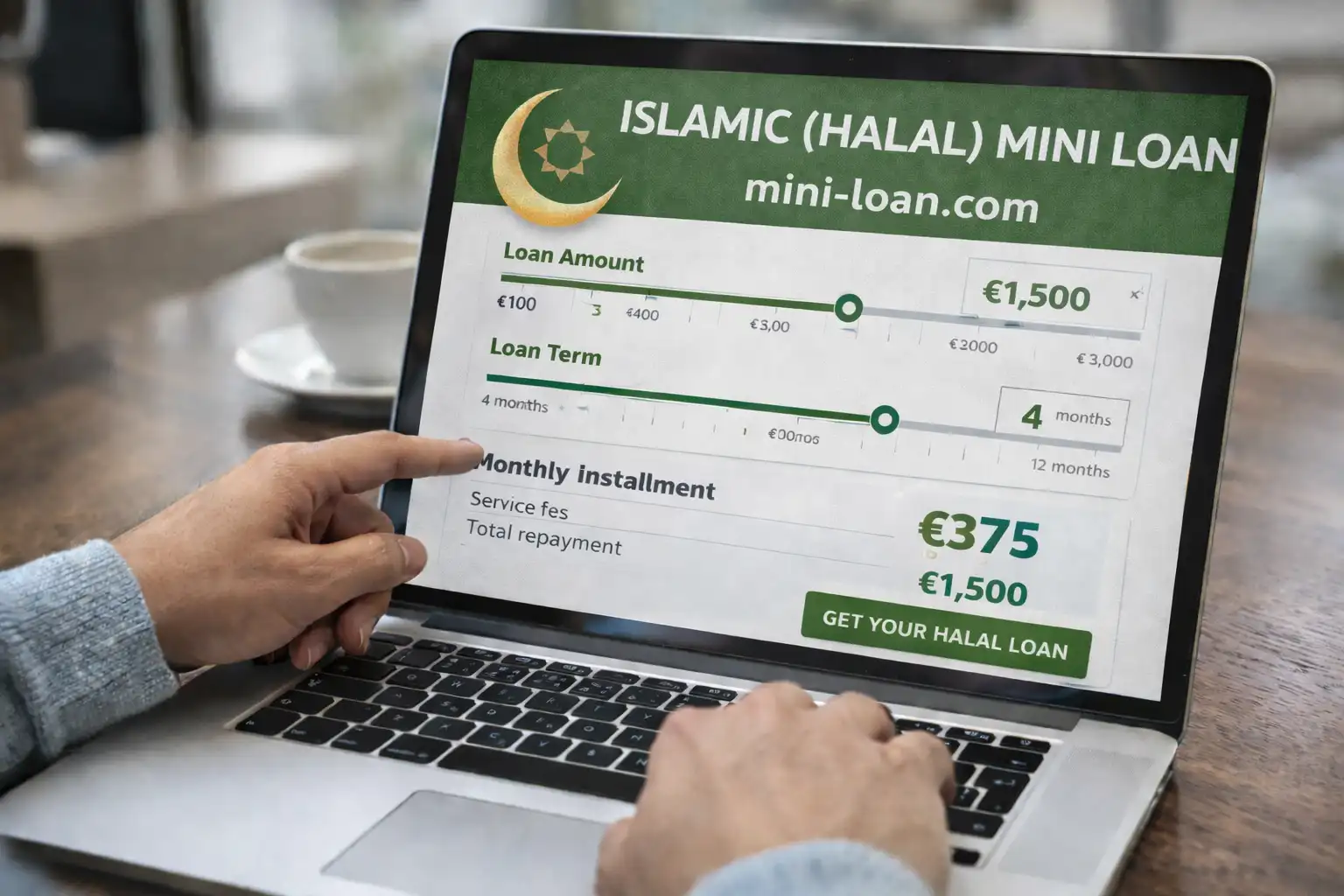
Many people who follow Islamic principles need a small sum for a deposit, a laptop, a repair or a family event, but do not want to pay or receive riba, the interest that conventional credit is built on. Islamic finance answers this with contracts in which the provider earns money through trade, rent or a fixed service fee rather than through interest charged on money lent.
This page explains how those contracts work for small amounts, how to tell a genuinely Sharia-compliant product from a conventional loan with a new label, and which alternatives exist when no Islamic provider offers what you need. Mini-pret.com does not lend, broker or recommend any provider.
What makes small financing Sharia-compliant
Islamic scholars generally agree on a few core principles. Money is not supposed to generate more money simply by being lent. Excessive uncertainty (gharar) and gambling-like speculation (maysir) should be avoided. The purpose of the financing should itself be permissible, so funding alcohol or gambling is excluded. Finally, risk and reward should be linked to a real asset or a real service.
In practice, this means the provider either buys something and sells it to you at a known mark-up, rents it to you, or lends you money with no return beyond the capital. Each structure has consequences for cost, ownership and what happens if you pay late.
The main structures used for small amounts
Qard hasan: the benevolent loan
Qard hasan is a loan where you repay exactly what you borrowed. It is the purest form, but it is rarely offered commercially because the lender earns nothing. You are more likely to find it through mosques, zakat and welfare committees, community funds or family arrangements. Some providers charge a small administration fee to cover real costs; scholars differ on how large such a fee may be.
Murabaha: cost-plus sale
With murabaha, the provider buys a specific item, such as a phone, furniture or a used car, and sells it to you for a higher price agreed in advance, payable in instalments. The profit is fixed at the start and should not grow if you take longer to pay. This is the most common structure for consumer goods.
Tawarruq: the commodity route to cash
When you need cash rather than an item, some providers use tawarruq: they sell you a commodity on deferred payment, and you (or they, on your behalf) immediately sell it on the market for cash. Many scholars accept it under conditions, while others consider it too close to an interest-bearing loan. If this matters to you, ask which Sharia board approved the product and read its reasoning.
Ijara: leasing
Ijara is a lease. The provider owns the asset and you pay rent; some versions end with ownership passing to you. It is more typical for cars and equipment than for very small sums.
How to compare the real cost
Even without interest, Islamic financing has a price. The profit margin in a murabaha or the rent in an ijara is a cost to you, and it is usually expressed as an equivalent APR so that you can compare it with conventional credit. Regulated providers in the UK must give you clear pre-contract information. Look at three figures side by side:
- the total amount you will pay back, including all fees;
- the monthly instalment and the number of instalments;
- the APR or annual equivalent rate shown in the documents.
Do not assume that a Sharia-compliant product is automatically cheaper. A fixed mark-up on a short term can work out more expensive than a credit union loan. To test different amounts and durations, use our repayment and cost calculator before you sign anything.
Late payment and charity clauses
Because the provider may not profit from your delay, many Islamic contracts replace late-payment interest with a charity clause: you agree to pay a set amount that is passed to charity rather than kept by the provider. A separate charge for genuine collection costs may still apply. Read this section of the contract closely: a missed instalment can still be reported to the credit reference agencies and harm your credit file, exactly as with a conventional loan.
Checking the provider before you apply
In the UK, anyone offering consumer credit or consumer hire must be authorised by the Financial Conduct Authority, whether the product is Islamic or not. The FCA does not judge religious compliance; it regulates conduct, affordability checks and fair treatment. Your checklist:
- search the firm by name and reference number on the FCA Financial Services Register;
- check that the website, phone number and email match the Register entry exactly;
- ask which scholars or Sharia supervisory board approved the product, and whether their opinion is published;
- make sure you receive written terms showing the sale price or rent, the schedule and any fees;
- confirm how complaints work and that you can go to the Financial Ombudsman Service if a regulated firm rejects your complaint.
Our page on small loan rules in Britain explains the wider framework in more detail.
Scam warning signs
Fraudsters know that people looking for "halal loans" may search in community groups and on social media, and they exploit that trust. Be wary of:
- anyone asking for an upfront "processing", "insurance" or "zakat" fee before the money is released;
- offers sent by private message on social networks, or via WhatsApp from a stranger;
- religious wording used as a substitute for a firm name, address and authorisation number;
- pressure to decide today or to keep the arrangement secret from family.
A genuine provider takes its charges from the financing agreement itself, never by bank transfer or gift card before you receive anything.
Realistic alternatives
If no Islamic product suits the amount or term, there are other routes that avoid interest or keep costs low:
- an interest-free arrangement with family or friends, written down with a simple repayment plan;
- community or mosque welfare funds offering qard hasan;
- government help such as a Budgeting Advance for people on certain benefits, which is repaid without interest;
- other zero-interest options that actually exist, including some employer salary advances;
- local welfare schemes and charitable grants, which do not need to be repaid at all.
If you are already struggling with existing payments, free debt advice from MoneyHelper or Citizens Advice is a better first step than any new financing, Islamic or not. Taking on another commitment to cover arrears can make the situation worse.
Questions worth asking before you sign
- Who owns the item or commodity, and at what moment?
- Is the profit fixed for the whole term, or can it change?
- What happens if I want to repay early: is part of the profit rebated?
- What exactly is charged if I pay late, and where does that money go?
- Is the provider authorised, and is the product covered by the Ombudsman?
Clear, written answers to these questions are the best sign that a product is both ethically sound and fairly priced. For a broader view of the types of small credit available, see our guide to small personal loans for everyday expenses.
Offers and lenders to compare
- Al Rayan Bank — Islamic bank offering Sharia-compliant finance.
- Gatehouse Bank — Islamic bank offering Sharia-compliant finance.
- Find Your Credit Union — credit union or cooperative lender offering affordable small loans.
Indicative, non-exhaustive list of real institutions, with no commercial link to this site. Check authorisation, APR and terms before applying; never pay fees upfront.